How to Reach Darknet Forums Without Deanonymizing Yourself
Most guides to reaching darknet forums tell you to turn on a VPN first, and that advice is close to worthless. A sourced field guide to what the Tor network actually looks like, what a VPN can be compelled to hand over, and the exact procedure that keeps your real IP out of it.
Almost every guide to reaching darknet forums gives the same advice: turn on a VPN, then open Tor Browser. That advice is close to worthless, and the reasons why are specific and documented. This guide covers what the Tor relay network measurably looks like right now, what happens at each hop of a circuit, the three occasions a VPN provider handed a user to law enforcement, why an anonymous browser sitting on a normal operating system leaks anyway, and the exact steps to reach darknet forums with the smallest possible footprint. Every claim is sourced, and where the evidence is weaker than the popular version of the story, this guide says so.
On this page
What darknet forums actually are
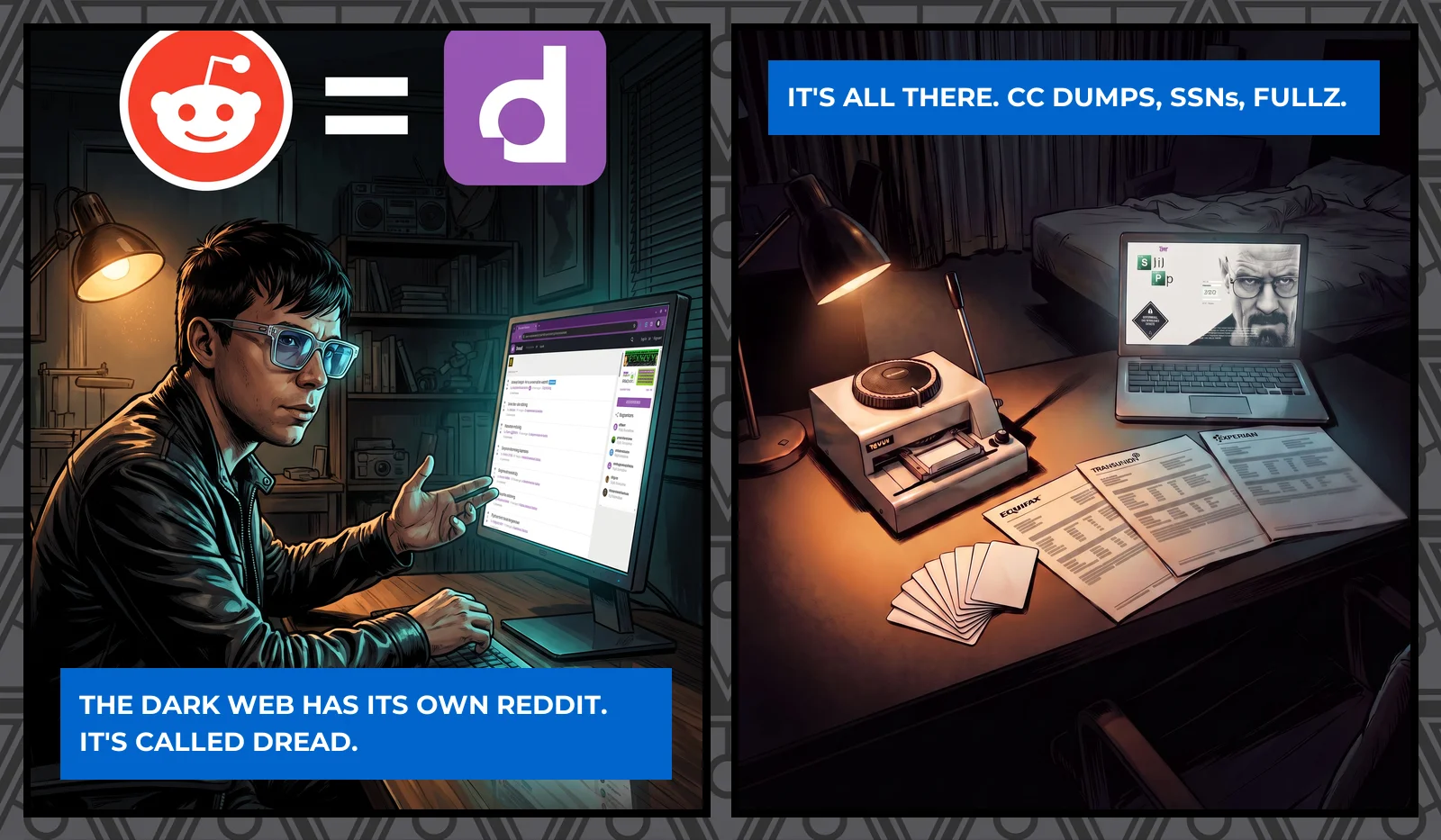
Dread is the best known of the darknet forums, an onion-only discussion board structured almost exactly like Reddit: subforums, post scores, comment threads, moderators. It launched in 2018, created by a pseudonymous administrator using the handle HugBunter, and it filled a gap that appeared when Reddit banned its darknet-market communities. Darknet forums are not marketplaces. They are where people argue about marketplaces, publish scam warnings, post exit-scam post-mortems, and dissect each other’s operational security failures in public.
That last part is the reason darknet forums matter to anyone studying this subject. Darknet forums where criminals publicly audit each other’s mistakes are among the better open sources on how people actually get caught, which is a different question from how people theoretically get caught.
The history of darknet forums is also a useful lesson in availability. In September 2019 the site disappeared abruptly, long enough that the community assumed a seizure or a dead-man’s switch; the administrator resurfaced that November attributing the outage to server failure. Through 2020 the operators added permanent mirrors and moved to a v3 onion address, and the site has spent the years since under near-constant denial-of-service pressure. The practical consequence for anyone visiting darknet forums is that addresses change, mirrors proliferate, and finding the correct address is itself the most dangerous step. We will come back to that.
The relay network, measured rather than assumed
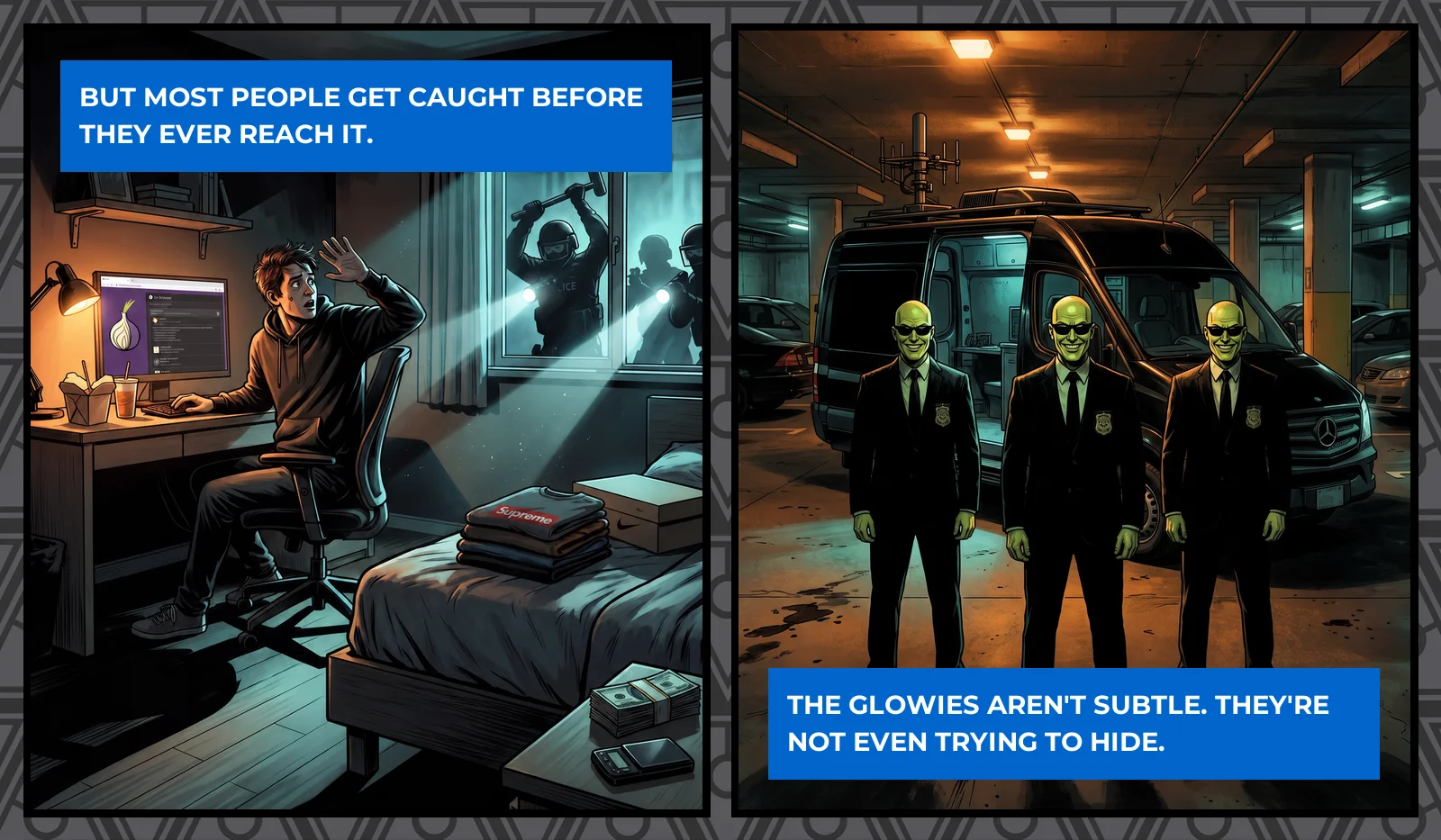
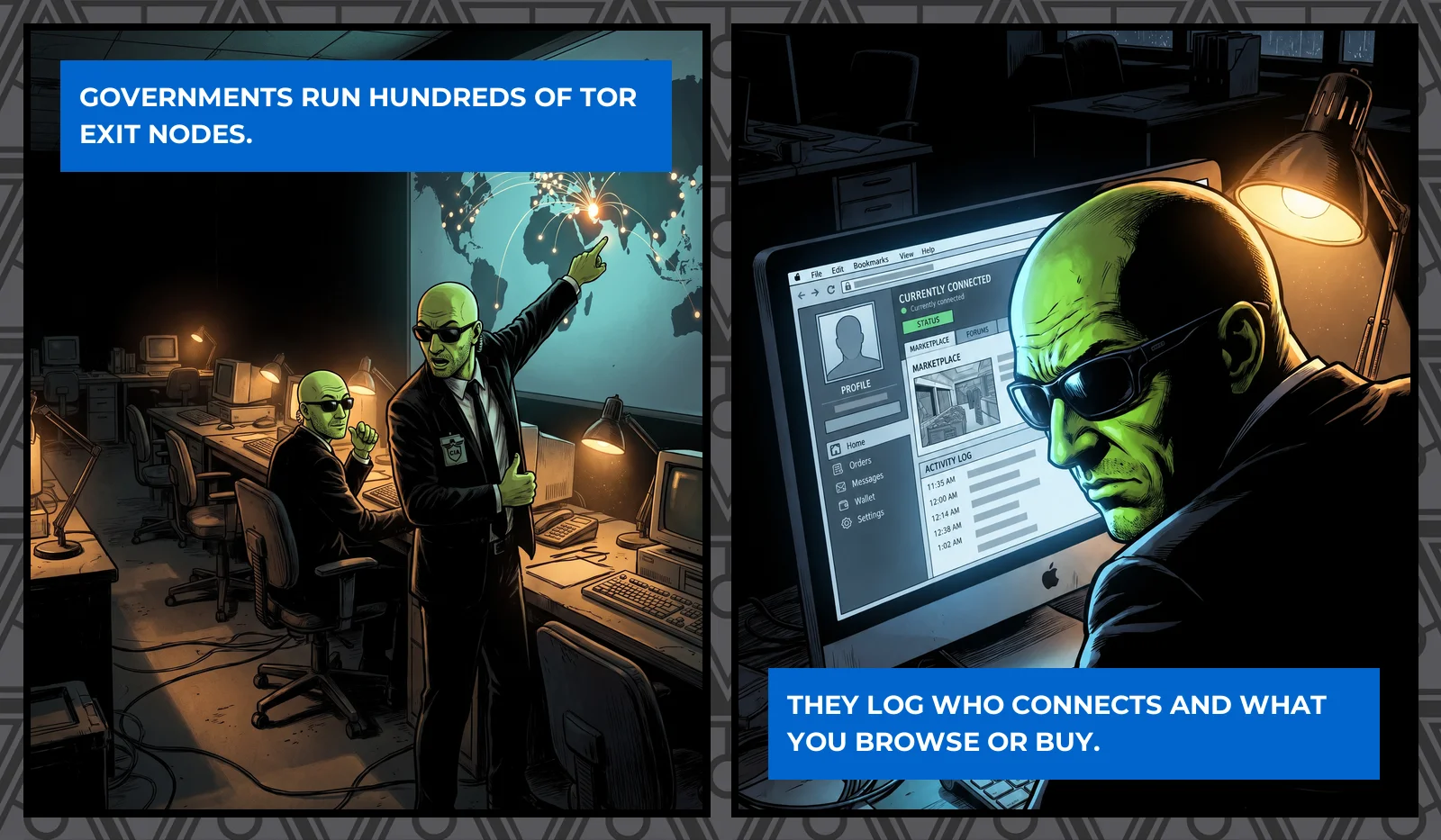
The popular version of this story is that governments run hundreds of Tor exit nodes to log who connects to darknet forums. The real picture is both less certain and more uncomfortable, and it is worth getting right, because the correct version changes what you should actually do about it.
Start with the size of the network. These figures come from Onionoo, the Tor Project’s own relay-status API, and they move constantly:
The network behind darknet forums
Every relay is volunteer-operated. There is no vetting requirement to join, and that is the design, not a flaw. It is also the entire problem.
That third number is the one worth sitting with. Between 2017 and 2021 a single actor, given the code name KAX17 by the independent researcher nusenu, ran what was measured at more than 900 concurrent relays across over fifty autonomous systems, advertising up to 155 Gbit/s of capacity. At its peak it accounted for roughly 16% of first-hop (guard) selections and 35% of second-hop (middle) selections. A worst-case snapshot from September 2020 put it at 10.34% guard, 24.33% middle and 4.6% exit simultaneously.
Where the popular version overstates the evidence: KAX17 was never attributed to any government. The researcher who documented it wrote plainly that “we have no evidence, that they are actually performing de-anonymization attacks, but they are in a position to do so.” Motive was recorded as unknown. Anyone telling you this was a confirmed state operation is filling in a blank that the source material deliberately left empty.
There is a second correction, and it is the more useful one. This operator was not primarily running exit relays. It concentrated on guard and middle positions, which is the harder and more interesting thing to do. Exit relays see plaintext, so they attract opportunistic criminals harvesting credentials and rewriting cryptocurrency addresses. Guard and middle relays see no content at all. There is nothing to steal there. The only reason to spend real money holding those positions is to observe who is using the network and to be present at both ends of enough circuits to correlate them.
So the accurate framing is not “governments run the exit nodes.” It is: an unidentified, well-funded actor held a large share of the entry and middle positions for at least four years, was partially removed twice, and rebuilt both times. The researcher’s own conclusion was that detecting and removing malicious relays at this scale “has become an impractical problem to solve.”
What each relay in your circuit knows
A standard circuit to darknet forums is three relays. The client builds it in layers, so each relay learns only the hop immediately before and after it. This is the property the whole system rests on, and it is worth being precise about who sees what.
| Position | Sees your real IP | Sees your destination | Can read content |
|---|---|---|---|
| Guard (entry) | Yes | No | No |
| Middle | No | No | No |
| Exit | No | Yes | Only if the traffic is not already encrypted |
Two details from this table do most of the work. First, no single relay ever holds both your identity and your destination, which is why breaking Tor’s encryption is not the attack anyone bothers with. Second, guards are deliberately sticky. Tor does not draw a fresh entry relay for every circuit; it keeps a small set for weeks at a time, on the reasoning that repeatedly rolling the dice on a new guard eventually lands you on a hostile one. Middle and exit relays rotate far more often, which means that the longer you use the network, the more distinct relays you pass through, and the higher the cumulative chance that some of them belong to the same operator.
Why “Tor over VPN” does not do what people think
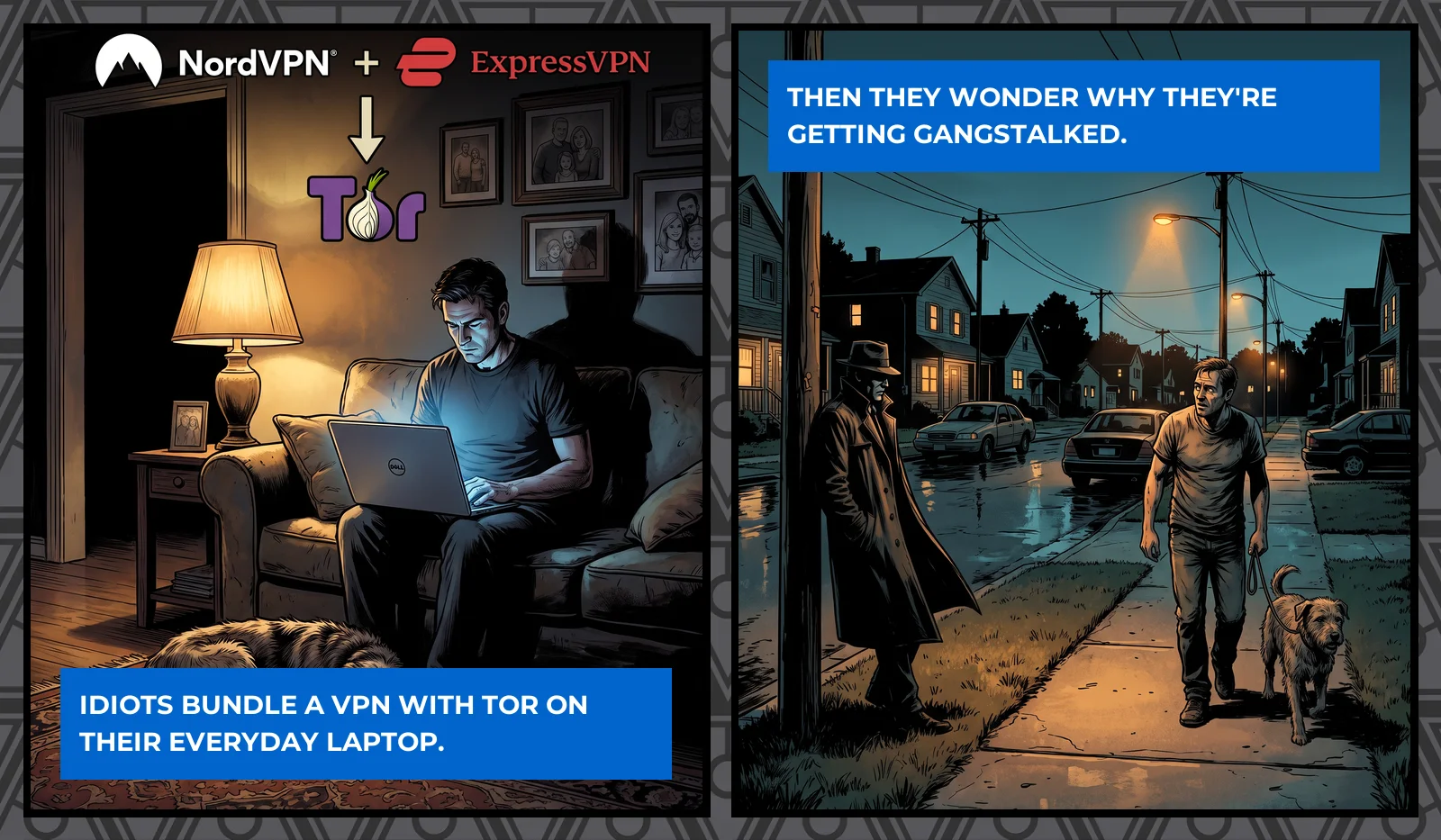
Tor Browser routes the traffic of Tor Browser. That is the entire scope of the guarantee. It is a browser, and a browser can only proxy its own process. Everything else on the machine keeps talking to the internet over your real address, the whole time you feel protected. Adding a VPN underneath moves the problem one hop; it does not remove it, because the leaks are happening outside the tunnelled application in the first place.
An adversary watching someone reach darknet forums does not need to defeat any cryptography. They watch two points and match the timing. Expand each leak path below.
Cloud sync clients
File-sync and photo-backup services maintain continuous connections and push changes the moment they happen, all over your real IP, all tied to an account with your name on it. They neither know nor care that an anonymity browser is open in another window. This is the single most common leak, because it is on by default on most consumer machines.
Operating-system telemetry
Both major desktop platforms maintain diagnostic and push-notification channels to their vendors as baseline behavior. These run whether or not you have opened a browser, they carry your real IP, and they are keyed to a stable device identifier. Turning them fully off is not a supported configuration on either platform.
IPv6 escaping the tunnel
Plenty of VPN configurations tunnel IPv4 correctly and let IPv6 route straight out of the default interface. If IPv6 is enabled and nothing is explicitly blocking it at the firewall level, a globally routable address that identifies your connection can be broadcast alongside traffic you believe is anonymized. This class of leak has been reported repeatedly and is still not handled by default in many clients.
Your ISP can see that you use Tor at all
Entry relay addresses are published in the public Tor consensus, so anyone watching your connection can see that you connected to the network, even though they cannot see what you did inside it. If the fact of Tor usage is itself a problem in your situation, pluggable transports such as obfs4 or Snowflake disguise the traffic as ordinary encrypted web browsing, but that requires deliberate configuration. Launching the browser does not enable it.
This is not a rumour, it is in the manual. The Tor Project’s own documentation states that “it is possible for an observer who can view both you and either the destination website or your Tor exit node to correlate timings of your traffic as it enters the Tor network and also as it exits,” and adds flatly: “Tor does not defend against such a threat model.” No VPN changes this, because the VPN is inside the part that is already encrypted.
The VPN receipts
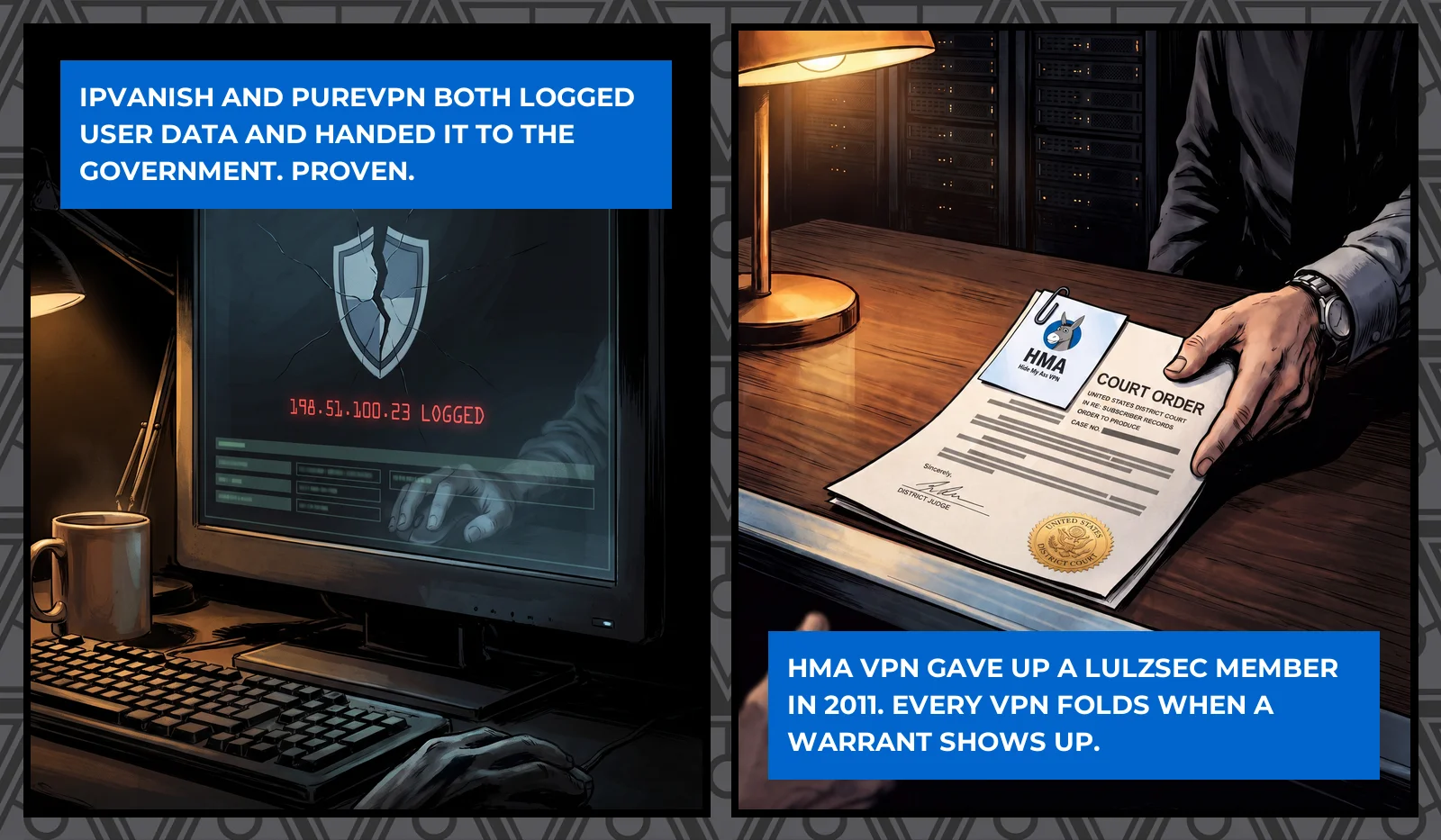
The argument against relying on a VPN to reach darknet forums is not hypothetical, and it does not require assuming bad faith. It requires only noticing that a company incorporated in a real jurisdiction, holding real servers, will comply with a real court order. Three cases are usually cited, and all three are worth stating accurately rather than dramatically.
| Case | Year | What was actually handed over |
|---|---|---|
| HideMyAss, LulzSec investigation | 2011 | Session and connection logs, produced under court order, used to help identify a suspect later sentenced over the Sony Pictures intrusion. |
| IPVanish, Homeland Security Investigations | 2016 | After initially indicating it held no usage data, the company produced the account name, email, subscription details, the real source IP and connection timestamps. |
| PureVPN, FBI cyberstalking case | 2017 | Connection records that linked one VPN IP to the suspect’s accounts, and then to his home and work IPs. |
The precise version, which is worse than the loose version: in none of these cases did a provider hand over browsing content. What they produced was connection metadata, which was sufficient every time. That is the actual lesson. You do not need a log of what somebody read. You need a timestamp, a source address and an account, and the identification follows. Marketing that promises no activity logs is frequently compatible with retaining exactly the metadata that identifies you.
The standard rebuttal is that modern providers now publish independent no-logs audits. Audits are genuinely useful evidence, and they are not immunity. An audit examines the systems the provider makes available to the auditor, at one point in time. It cannot compel disclosure of infrastructure outside its scope, it cannot bind future behavior, and it has no effect whatsoever on a court order. The only question that matters when the order arrives is whether the data exists at that moment. Everything else is a claim about intent.
One device, two lives
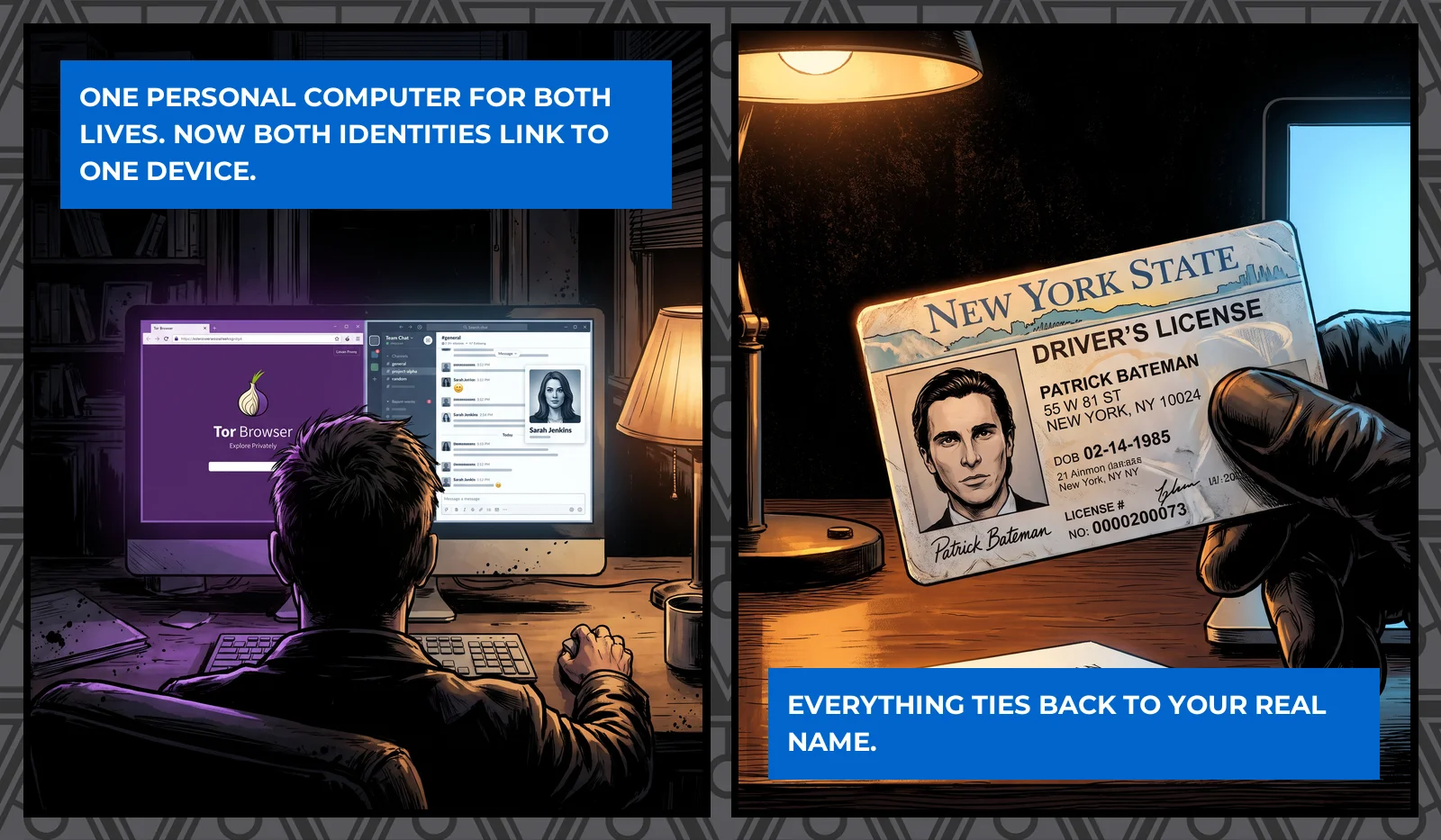
Everything above concerns the network that carries darknet forums. This section concerns the machine, and it is where most real-world identification actually happens.
If the computer you use to read darknet forums is also the computer holding your mail, your photo library, your password manager and your logged-in sessions, then the two identities are already joined at the hardware. It does not take a sophisticated attack to connect them. It takes one process that does not respect the proxy, one autofilled field, one notification, one file saved to the wrong folder, one session cookie surviving a restart. The failure mode is not cryptographic. It is a normal computer behaving normally, which is what it will do, because that is what it was built to do.
Browser fingerprinting compounds it. Screen resolution, installed fonts, GPU, timezone and a few dozen other attributes combine into an identifier that works without cookies. The EFF’s long-running measurement put unique fingerprints at 83.6% of browsers tested, and engineering work published by Brave showed that combining as few as five or six attributes already produces a better than 90% unique signature. Tor Browser fights this deliberately by making all its users look alike, which is exactly why customizing it defeats the point. Every extension you add, every window you resize, every font you install makes you rarer, and rare is the opposite of anonymous.
A browser cannot fix an operating-system problem
Follow the previous two sections to their conclusion and the shape of a safe route to darknet forums is forced. If the leaks come from outside the browser, the anonymity has to be enforced from outside the browser. If the forensic residue is written by the host operating system, the answer is not to clean up afterwards, it is to never write to that disk at all.
That means an operating system that boots from removable media, runs in RAM, forces every connection through Tor at the network layer rather than the application layer, and blocks anything that tries to route around it. Under that model a misbehaving background process cannot leak, because there is no path for it to leak through. Nothing persists after shutdown, because nothing was written. The host machine’s own installation is never mounted, so its telemetry, its sync clients and its stored credentials are simply not running.
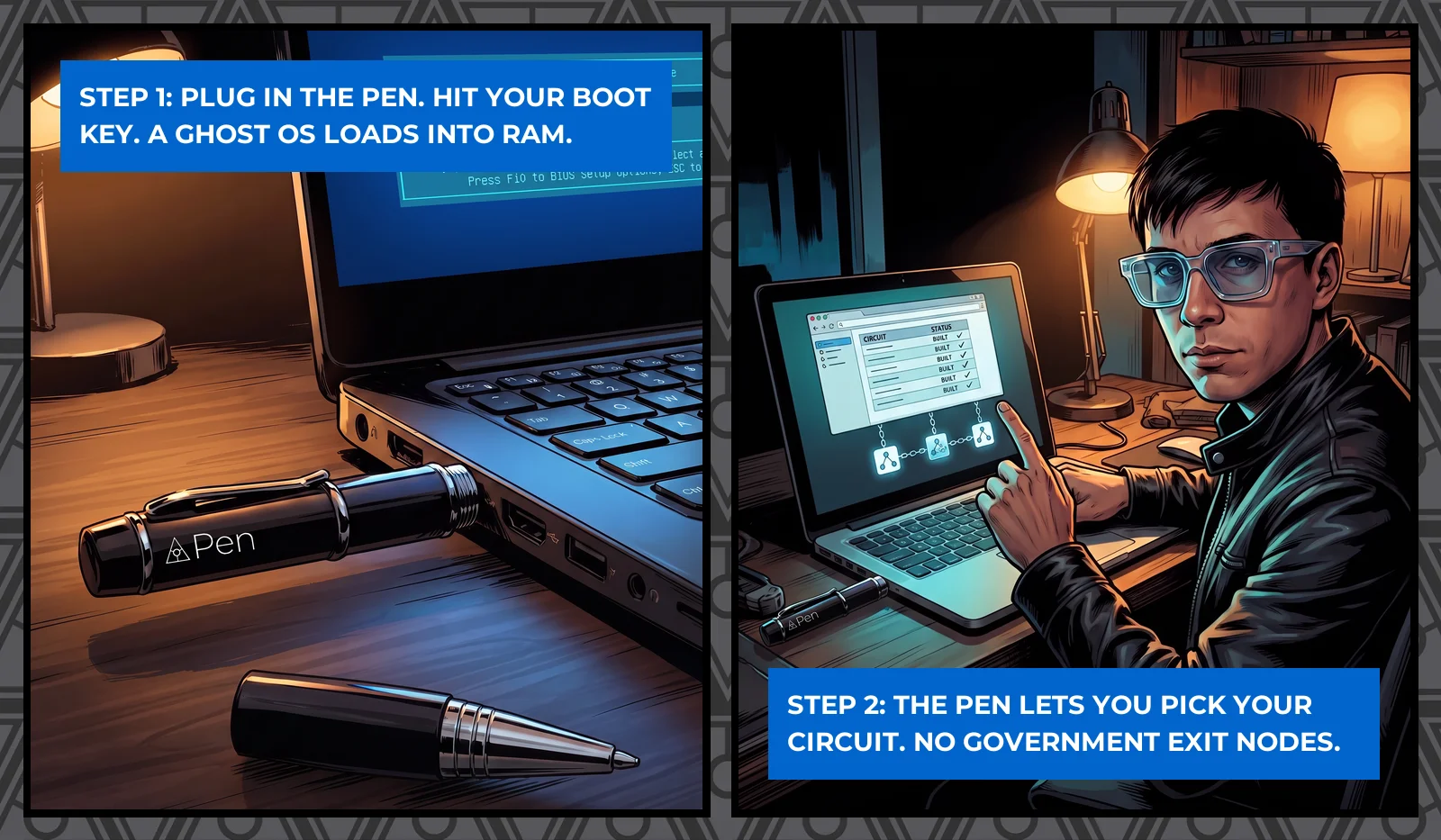
This is the model the Zero Trace Pen ships. Plug it in, interrupt the normal startup with your machine’s boot key, and an isolated environment loads into memory with Tor enforced at the operating-system level. It includes a circuit viewer so you can inspect your three relays directly, along with an anonymous Bitcoin wallet and an encrypted messenger, because the people who need one generally need the others and bolting them on afterwards is precisely how mistakes get made. Pull the drive and the session ceases to exist. There is nothing to recover forensically because nothing was ever committed to disk.
What this does not do: an amnesic system removes the leaks and the residue. It does not make you invisible. A network observer can still see that you connected to Tor, an observer positioned at both ends can still attempt timing correlation, and nothing at all protects you from typing your own name into a form. The tool fixes the machine. It cannot fix the operator.
How to reach darknet forums, step by step
This is the full procedure for reaching darknet forums with the smallest footprint available on ordinary hardware. Do the steps in order.
- Boot the isolated environment. Insert the drive and interrupt the normal startup by pressing your machine’s boot key. It differs by manufacturer, commonly F12, F10, Esc or the Option key, and it must be pressed before the host operating system begins loading. If your usual desktop appears, you missed the window; restart and try again.
- Join a network, then stop. Connect to WiFi and do nothing else yet. Do not sign into anything. The environment establishes its Tor connection on its own before any application traffic is permitted.
- Inspect your circuit. Open the circuit view to see your three relays: entry, middle and exit, with the country of each. This is the one moment you can actually observe the thing everyone else is guessing about. If the circuit looks wrong for your situation, request a new one before you browse.
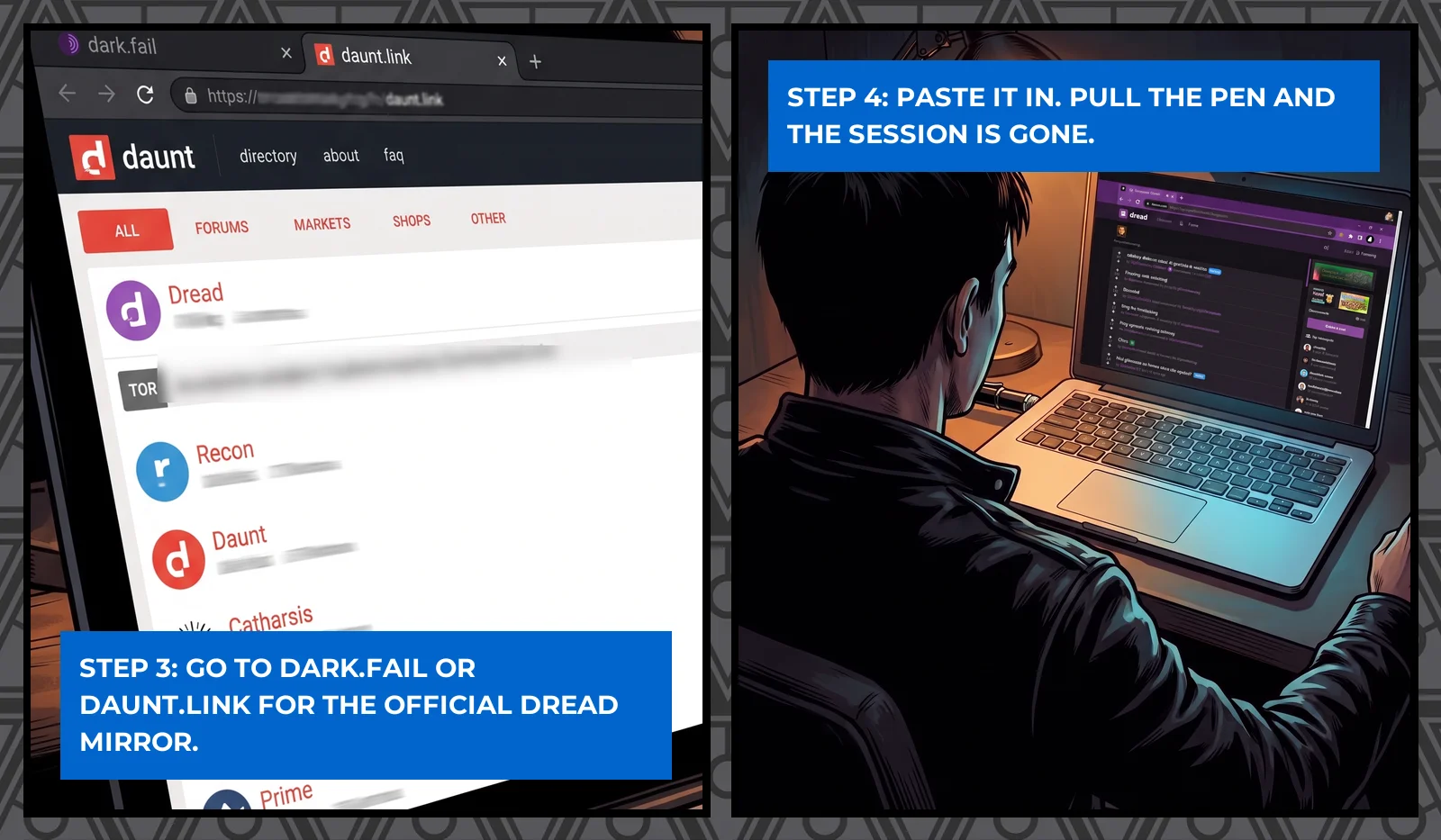
- Get the address from a directory you verify, not a search engine. The onion addresses for darknet forums are long random strings, which makes them trivial to typo-squat and impossible to eyeball. Established link directories such as dark.fail exist because of this, and they sign their listings with PGP. Verify the signature. An unsigned mirror list, or a link from a forum post, a chat message or a search result, is the standard delivery mechanism for a credential-harvesting clone.
- Paste the address into a fresh tab. Type or paste it directly. Do not search for darknet forums by name. Expect a queue on busy darknet forums; that is normal, and impatience is exactly what pushes people onto the fake mirror that has no queue.
- Change nothing. No extensions, no window resizing, no additional fonts, no signing into an existing account, no reusing a password from anywhere else. Every deviation makes your fingerprint rarer.
- Shut down completely when finished. Pull the drive and power off. Do not suspend, do not leave it running. Memory is cleared on shutdown, and that is the step that makes the whole exercise amnesic rather than merely private.
Method comparison
How the common approaches to reaching darknet forums compare, side by side:
| Method | Hides your IP from the site | Stops non-browser leaks | Leaves no local trace |
|---|---|---|---|
| Normal browser, private window | No | No | No |
| VPN alone | From the site, not from the provider | No | No |
| Tor Browser on your everyday machine | Yes | No | Partially |
| VPN plus Tor Browser on your everyday machine | Yes | No | Partially |
| Amnesic OS with Tor enforced system-wide (Zero Trace Pen) | Yes | Yes | Yes |
Note that rows three and four are identical in every column that matters. That is the entire argument of this guide in one line: adding a VPN to a leaking machine changes nothing about the leaks. The only row that moves the outcome for anyone using darknet forums is the one that changes the operating system rather than the browser.
What still gets people caught on darknet forums
Worth ending on the uncomfortable part. The overwhelming majority of identifications tied to darknet forums are not the result of a broken circuit or a defeated cipher. They come from reused usernames, a password that also appears in a breach dump, a cryptocurrency address linked to a verified exchange account, a photograph carrying location metadata, a writing style that matches a decade of public posts, or simply telling somebody. The network layer is the part that gets written about because it is technically interesting. It is not the part that fails.
Set up the machine correctly before you go near darknet forums, then behave as though the machine is the easy half. It is.
Sources
- Tor Project, Attacks on onion routing, on traffic correlation and the stated threat model.
- nusenu, Is “KAX17” performing de-anonymization Attacks against Tor Users?, 29 November 2021, for relay counts, guard and middle probabilities, and the explicit absence of attribution.
- Tor Metrics and the Onionoo relay-status API, for live relay and exit counts. Figures in this guide were read on 27 August 2026 and change continuously.
- Tor Project download page, the only source from which to obtain Tor Browser.
- EFF, Cover Your Tracks, for browser fingerprinting uniqueness measurement.
- U.S. Department of Justice, sentencing announcement in the Sony Pictures intrusion, for the disposition of the LulzSec case referenced above.
- Tor Project, relay-early traffic confirmation advisory, for the documented precedent of an attack executed from non-exit relay positions.
This guide to darknet forums is published for privacy education and threat modelling. It describes how anonymity systems work and how they fail. It is not an endorsement of any activity conducted on the services described.